
Places · 23 October 2026
Tiny houses and light homes in Morocco: what the law says
Do you need a permit to set a tiny house down in Morocco? The answer depends above all on where the land is and how the home will be used. What the texts provide, and how to prepare the file.
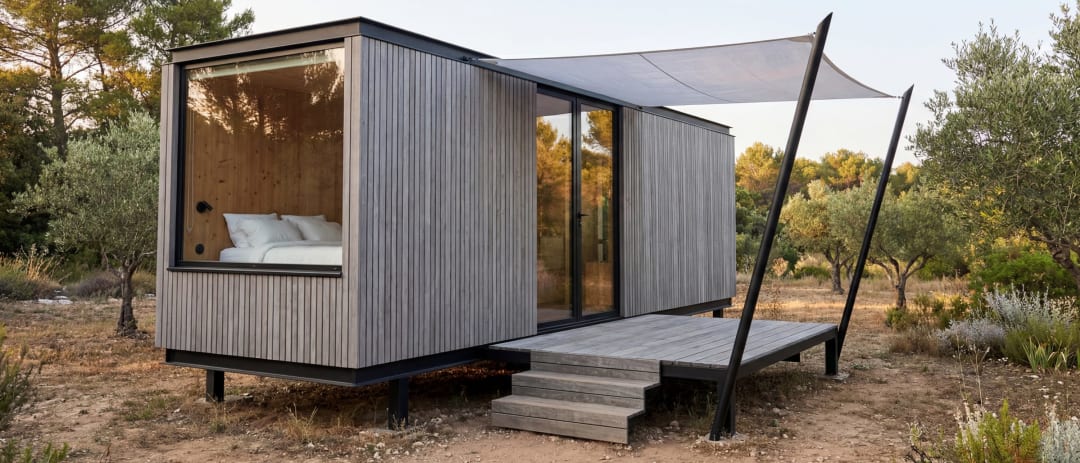
We are often asked: do you need a building permit for a tiny house in Morocco? The honest answer is: it depends. On where the land is, on the nature of the installation and on how it will be used. Here is what the texts say, as we have read them, and how we prepare files with our clients.
This article is not legal advice. For your land, the municipality decides which procedure applies.
Where the land is comes first
Law 12-90 on urban planning (article 40) makes a building permit compulsory:
- in urban municipalities and delimited centres;
- in the areas surrounding towns and in urban planning groupings;
- in special-purpose zones.
Outside these perimeters, it is still compulsory within one kilometre of non-municipal roads and railways, within five kilometres of the maritime public domain, and in housing estates.
So the first question is: where exactly is the land? A rural plot, away from main roads and the coast, falls under different rules from a plot on the edge of a town.
The nature of the installation matters
The general building regulations (decree 2-18-577, article 20 and annex 4) provide for seasonal or occasional installations. They follow a lighter procedure: a permit issued by the president of the municipality within ten working days.
A home set on point supports, transportable in one piece, able to leave the way it arrived, comes close to this category. The text does not name it: it is an argument to put to the municipality, which assesses it case by case.
Tourism use has its own framework
If the home welcomes travellers, law 80-14 on tourist establishments applies. It lists light dwellings among tourist accommodation (article 3) and recognises alternative accommodation, set in the mountains, in the desert or on any site of tourist interest (article 29).
Decree 2-23-441 (articles 60 to 65) sets the procedure: an application to the local authority, an answer within thirty days, an authorisation valid for five years and renewable. In place of an occupancy permit, it accepts a certificate from a specialist engineer attesting to safety, strength, stability and fire prevention (article 61).
This operating authorisation comes on top of the others: law 80-14 states that it does not exempt from any authorisation required elsewhere (article 32). Planning rules still apply.
Land and utilities
A few points to check before any application:
- the land title, or the legal status of the land;
- boundary marking and a topographic survey;
- access for the truck and crane on installation day;
- water, electricity and wastewater: mains connection, or autonomy with solar panels, a water tank and on-site treatment.
Building without authorisation
Law 66-12 on the control and punishment of planning offences provides for heavy fines, and demolition can be ordered. A tiny house's small size does not place it outside these rules.
How we prepare the file
- We place the land against the perimeters of article 40.
- We recommend an early meeting with the municipality's planning department; the studio can attend.
- We supply the technical documents: site plan, plans, sections and elevations, descriptive note, structural calculations, engineer's certificate.
- For tourism use, we also prepare the documents for the alternative accommodation file.
The exact content of the file varies from one municipality to another. It is best to know it before ordering.
To review your land, book a 20-minute call with the studio.
Let's talk about your project
The brochure presents our homes, our bespoke approach and our prices. You can also book a 20-minute call with the studio.